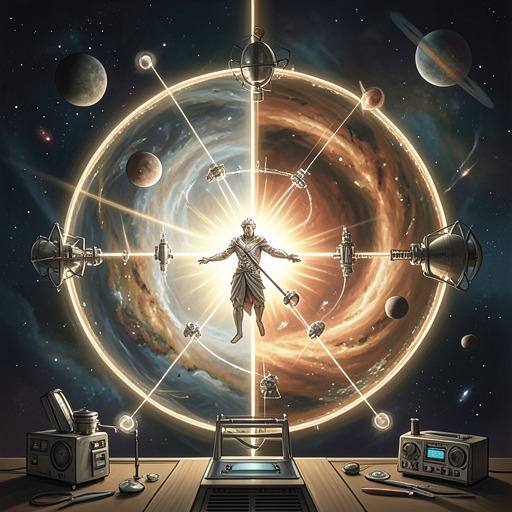
The Great Chain of Being
Paradise LostThe Great Chain of Being is the hierarchical model of creation explained by Raphael to Adam: all things proceed from God and return to him unless they have been corrupted from the good, while created substances occupy varied degrees of bodily and spiritual refinement. The model links cosmology to ethics. Human happiness is granted by God but preserved only through freely chosen obedience, so the chain describes not merely what exists but the conditions under which created beings remain in their proper relation to their source.
Definition and Cosmic Order
The chain begins with one first matter, endowed with different forms, degrees of substance, and degrees of life. Created things are placed nearer to God or farther from him according to their refinement and spiritual activity, each assigned its own active sphere and limits proportioned to its kind. Raphael presents this order as continuous rather than absolutely divided: body works upward toward spirit, and each level is capable of receiving, transforming, and transmitting what sustains it.
The hierarchy is also nutritional. Every created thing needs to be sustained and fed, and the grosser elements feed the purer ones: Earth feeds the Sea, Earth and the Sea feed Air, Air feeds the ethereal Fires, and the Moon stands at the lowest point of that celestial sequence. The Sun receives alimentary recompense from the surrounding world in humid exhalations, even though Heaven possesses its own ambrosial trees, nectar-bearing vines, and pearly dew. Matter therefore remains active throughout the cosmos; nourishment is the process by which one degree is converted into another.
The Scale from Plant to Spirit
Raphael makes the chain intelligible through the movement of plant life. From the root rises the lighter green stalk, from the stalk the more airy leaves, and finally the bright flower, whose fragrant breath represents a further refinement. Flowers and fruits nourish human beings, and that nourishment is progressively sublimated into vital spirits, animal life, and intellectual power. Life, sense, imagination, and understanding thus appear as stages of one ascending process rather than unrelated faculties.
The soul receives reason through this progression. Human reason may operate discursively, moving through successive acts of thought, or intuitively; angels possess the latter mode more fully, but the difference is one of degree rather than kind. Raphael’s formulation places human and angelic cognition on the same scale while preserving their unequal refinement. The human being is not a separate order sealed off from the rest of creation, but a participant in a graded continuum whose higher possibilities remain open.
Bodies, Angels, and Possible Transformation
The chain explains why Raphael can eat earthly food without ceasing to be an angel. Like human beings, angels possess within themselves the lower faculties of sense: they hear, see, smell, touch, taste, digest, assimilate, and turn corporeal substance into incorporeal substance. Raphael and Eve therefore share a meal in which physical nourishment is not treated as a contradiction of spiritual nature. Angelic substance is more refined, but it remains capable of conversion.
Raphael extends this principle into the future of humanity. If Adam and Eve remain obedient and retain God’s love without alteration, their bodies may, over time, become wholly spiritual, ascend ethereally on wings, and dwell either on Earth or in heavenly paradises. The possibility is conditional rather than automatic. Humanity’s place in the chain can be elevated, but elevation depends upon maintaining the relation that gives created life its order. The chain thus joins biological transformation to moral perseverance.
Human Knowledge and the Limits of Cosmology
Adam applies the chain to the visible universe and becomes troubled by the apparent disproportion between the small Earth and the vast, swiftly moving heavens. He wonders why so many greater and brighter bodies should perform, as far as he can see, the single service of illuminating one small world. Raphael does not simply command him to stop asking. He says that Heaven is set before human beings as the Book of God, inviting them to study its works and seasons, but that the Architect has concealed the ultimate arrangement of the heavens rather than divulging every secret to human or angelic scrutiny.
This limit does not cancel reason; it disciplines it. Raphael entertains alternative accounts of celestial motion, including the possibility that the Sun is the center and that the Earth has several imperceptible motions. He also suggests that the Moon might receive Earth’s light, possess clouds and rain, and sustain fields and inhabitants, while other suns might have attendant moons and living beings of their own. These possibilities enlarge the created order without allowing Adam to mistake conjecture for revealed certainty.
Greatness, Use, and Divine Perspective
Raphael rejects Adam’s assumption that physical magnitude or brightness proves superiority. Earth, though small and not glittering when compared with Heaven, may contain a greater abundance of solid good than the barren Sun, whose beams become fruitful only after they are received by Earth. The luminous bodies are not made merely for Earth in a narrow sense; their vastness displays the magnificence of their Maker and reminds humanity that it does not inhabit a universe made solely for its own measure.
The chain therefore unsettles simple human centrality without denying human significance. The heavens may have uses known only to their Lord, and their spacious architecture exceeds humanity’s capacity to fill or comprehend it. Yet celestial light, terrestrial fruitfulness, intellectual reason, and the prospect of spiritual ascent all belong to one ordered creation. Difference of scale does not produce chaos; it reveals a hierarchy in which apparent lowliness may contain a richer form of good than apparent splendor.
Freedom, Obedience, and the Possibility of Fall
The decisive ethical principle of the Great Chain of Being is that perfection does not mean immutability. God made Adam perfect and good, but left perseverance within his power and ordained his will to be free, not ruled by inescapable fate or strict necessity. God requires voluntary service, because a will that can do only what it must cannot be tested as willing obedience. Happiness is therefore received from God but continued through the creature’s own free response.
Raphael makes the principle universal by including the angelic host. Angels retain their blessed state only while obedience holds; they have no other security. Some have already fallen through disobedience from Heaven into deepest Hell. Their fall demonstrates that the chain is not a mechanism that guarantees moral stability. Created beings occupy ordered places, but their relation to God must be actively maintained. The same structure that permits ascent also makes collapse possible.
For Adam, this warning interrupts his confidence that love and obedience will never fail. The single command appears just and the gifts of creation seem to make disobedience unthinkable, yet Raphael’s account introduces doubt precisely where Adam expected assurance. The chain’s deepest lesson is consequently a paradox: created order is secure in its source, but not in the freedom of the beings who inhabit it. Their dignity lies in voluntary love, and their danger lies there as well.